


Can sleeping under direct AC airflow cause facial paralysis? Learn the facts, warning signs, Bell’s palsy symptoms, and when to seek care.
AC and facial paralysis, Bell’s palsy symptoms, facial paralysis warning signs, facial nerve weakness, sleeping under air conditioner, causes of facial paralysis.
Can Air Conditioning Cause Facial Paralysis?
Sleeping with an air conditioner running can make hot summer nights much more comfortable. However, you may have heard warnings that allowing cold air from an AC unit or fan to blow directly onto your face while sleeping can cause facial paralysis or Bell’s palsy.
But is there any truth to this claim?
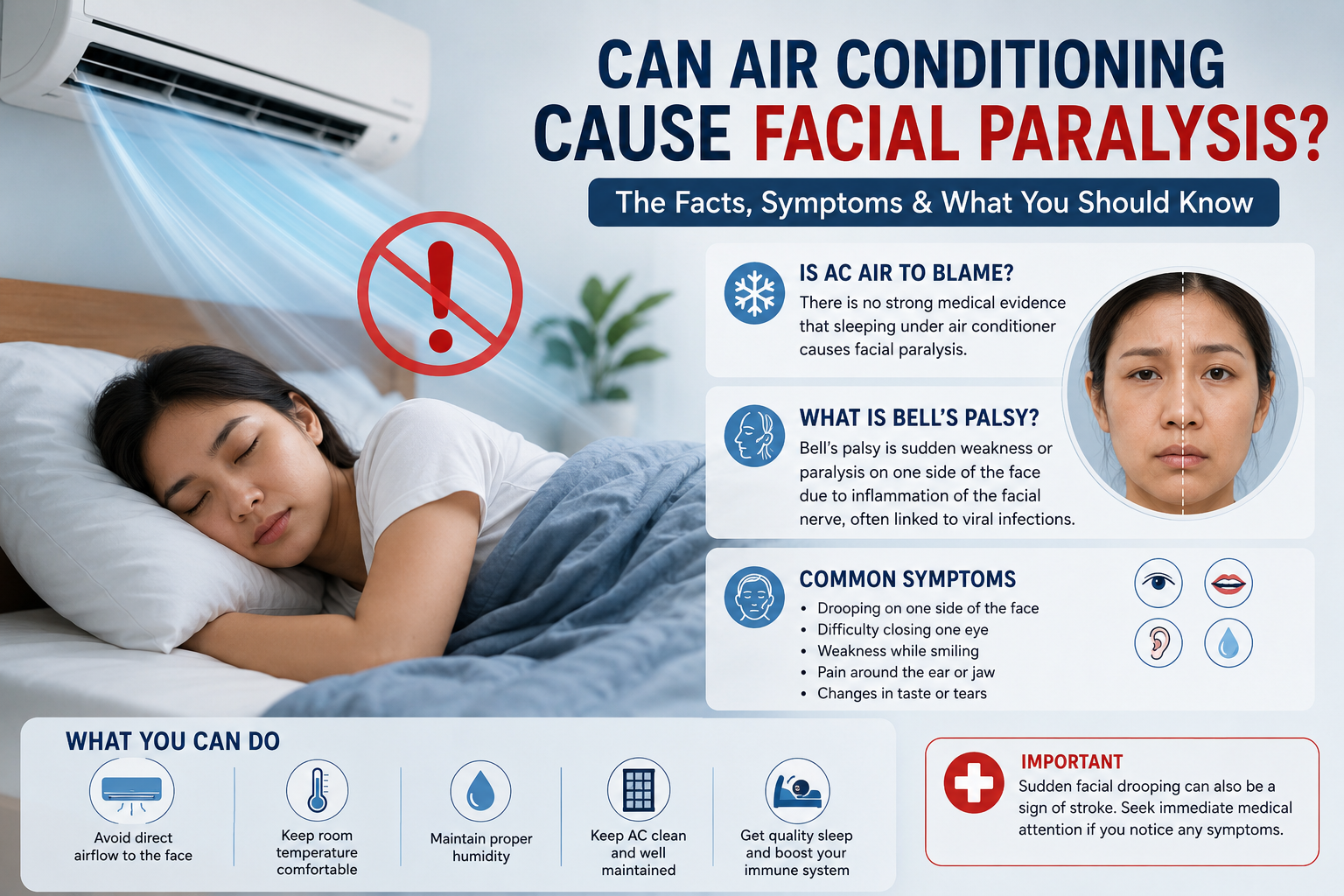
Current medical evidence does not establish direct exposure to air conditioning as a proven cause of Bell’s palsy. Bell’s palsy is a neurological condition involving sudden weakness or paralysis of the muscles on one side of the face. The exact cause remains uncertain, although inflammation and swelling of the facial nerve—often associated with a viral infection or reactivation—are believed to play an important role.
That does not mean sleeping directly under powerful cold airflow is always comfortable or advisable. Continuous cold air directed toward the face may contribute to dry eyes, nasal irritation, muscle discomfort, or poor sleep in some people. However, these effects should not be confused with evidence that an air conditioner directly damages the facial nerve.
Understanding the real symptoms and causes of facial paralysis is particularly important because sudden facial weakness can sometimes indicate a stroke, which requires immediate medical attention.
What Is Facial Paralysis?
Facial paralysis occurs when the muscles of the face become weak or unable to move normally because the nerves controlling them are affected.
One of the most common causes of sudden one-sided facial paralysis is Bell’s palsy. It usually affects only one side of the face and may develop over several hours or a few days.
The facial nerve, also called the seventh cranial nerve, controls many important functions, including:
- Smiling and other facial expressions
- Closing the eyelids
- Raising the eyebrows
- Movement around the mouth
- Some aspects of tear and saliva production
- Part of the sensation of taste
When this nerve becomes swollen or inflamed, signals between the brain and facial muscles can become disrupted, producing facial weakness or paralysis.
Can Sleeping Under an Air Conditioner Cause Facial Paralysis?
There is currently no strong medical evidence showing that sleeping directly under an air conditioner causes Bell’s palsy.
The exact cause of Bell’s palsy remains unknown. Researchers believe inflammation of the facial nerve may occur following certain viral infections or immune responses. Viruses associated with Bell’s palsy include herpes simplex, herpes zoster, Epstein-Barr virus and several viruses responsible for respiratory illnesses.
Therefore, claims such as “cold AC air causes facial paralysis” should be treated cautiously.
Cold exposure may sometimes coincide with the development of symptoms, which can lead people to assume that the air conditioner caused the condition. Coincidence, however, does not prove that direct airflow caused the nerve inflammation.
Why Do People Associate Cold Air With Bell’s Palsy?
Bell’s palsy often appears suddenly. Someone may go to bed feeling normal and wake up with one side of the face weak or drooping.
If that person slept next to an air conditioner, fan or open window, the cold airflow may naturally be blamed.
However, medical authorities describe Bell’s palsy as an acute facial nerve disorder of uncertain cause rather than a condition caused specifically by cold air.
What Actually Causes Bell’s Palsy?
The exact mechanism is still being studied.
Bell’s palsy develops when the facial nerve becomes irritated, inflamed and swollen. Because part of the nerve travels through a narrow bony passage in the skull, swelling can interfere with normal nerve signals to the facial muscles.
Viral infections or viral reactivation are thought to be possible triggers.
Viruses that have been associated with Bell’s palsy include those responsible for:
- Cold sores
- Genital herpes
- Chickenpox
- Shingles
- Infectious mononucleosis
- Some respiratory infections
- Influenza
- Mumps
- Rubella
Having one of these infections does not mean a person will develop Bell’s palsy.
Who May Have a Higher Risk?
Bell’s palsy can occur at almost any age, but certain conditions have been associated with a higher likelihood of developing it.
According to Mayo Clinic, Bell’s palsy occurs more frequently among people who:
- Have diabetes
- Have high blood pressure
- Have obesity
- Recently had an upper respiratory infection
- Are pregnant, particularly during the third trimester
- Are within the first week after giving birth
Rarely, Bell’s palsy can recur, and recurrent cases may sometimes be associated with a family history.
Early Warning Signs of Facial Paralysis
Bell’s palsy can develop quickly, sometimes within hours. Because of this sudden onset, there may not always be an obvious warning period.
However, some symptoms can appear around the time facial weakness begins.
Pain Around or Behind the Ear
Some people experience discomfort around the jaw, ear or behind the ear on the affected side.
Changes in Facial Movement
A person may notice that smiling feels unusual or that one side of the face does not move as easily as the other.
Difficulty Closing One Eye
The eyelid on the affected side may become difficult or impossible to close completely.
Changes in Taste
Bell’s palsy can sometimes affect taste because the facial nerve is involved in taste sensation.
Changes in Tears or Saliva
Some patients experience a watery or unusually dry eye or changes in saliva production.
These symptoms require medical assessment rather than self-diagnosis.
Common Symptoms of Bell’s Palsy
The most recognizable symptom is sudden weakness affecting one side of the face.
Symptoms may include:
- Drooping of one side of the face
- A drooping corner of the mouth
- Difficulty smiling normally
- Difficulty raising an eyebrow
- Difficulty closing one eye
- Drooling
- Dry or watering eye
- Dry mouth
- Loss or alteration of taste
- Pain around the jaw or behind the ear
- Increased sensitivity to sounds on the affected side
- Difficulty eating or drinking
Symptoms generally develop over hours to a few days.
Facial Paralysis or Stroke? Know the Difference
This is the most important section of the article.
Never assume sudden facial drooping is simply Bell’s palsy.
Facial weakness can also be a symptom of stroke. Mayo Clinic recommends seeking immediate medical help for any new paralysis because Bell’s palsy and stroke can produce similar symptoms.
Emergency warning signs can include:
Face: One side suddenly droops.
Arms: One arm becomes weak or cannot stay raised.
Speech: Speech becomes slurred, confused or difficult.
Time: Seek emergency medical care immediately.
The NHS specifically identifies facial drooping accompanied by arm weakness or speech difficulty as possible signs of stroke requiring emergency treatment.
Do not wait to see whether the symptoms disappear.
How Is Bell’s Palsy Diagnosed?
There is no single laboratory test that confirms every case of Bell’s palsy.
A healthcare professional generally examines facial movement and may ask the patient to:
- Close both eyes
- Raise the eyebrows
- Smile
- Show the teeth
- Frown
- Perform other facial movements
Other disorders can also produce facial weakness, including stroke, certain infections, inflammatory diseases and tumors. When the diagnosis is unclear, doctors may use tests such as MRI, CT imaging, electromyography or blood tests to investigate other possible causes.
How Is Bell’s Palsy Treated?
Treatment depends on the patient’s symptoms, severity and medical history.
Corticosteroids
Corticosteroid medicines such as prednisone may be prescribed to reduce inflammation and swelling around the facial nerve.
Early treatment is important. The NHS states that treatment for Bell’s palsy is more effective when started within 72 hours of symptom onset.
Antiviral Medicines
Antiviral medicines may occasionally be given together with corticosteroids, particularly in some severe cases.
However, Mayo Clinic notes that the benefit of antivirals remains uncertain and that antiviral treatment alone has not demonstrated the same established benefit as corticosteroid therapy.
Eye Protection
Eye care is one of the most important parts of treatment when the affected eyelid cannot close completely.
Failure to protect the eye can result in severe dryness and damage to the cornea.
A healthcare professional may recommend:
- Lubricating eye drops
- Eye ointment
- Protective glasses
- Eye covering or appropriate eyelid protection at night
Physical Therapy
A physical therapist may recommend appropriate facial massage or exercises for selected patients.
These exercises should preferably be performed according to professional advice rather than aggressively exercising weakened muscles without guidance.
Surgery
Surgery is rarely required for Bell’s palsy.
Facial reanimation or reconstructive procedures may occasionally be considered for people who develop lasting facial nerve problems, while traditional facial nerve decompression surgery is generally not recommended because of its risks.
How Long Does Bell’s Palsy Last?
Recovery varies considerably from person to person.
Many people begin noticing improvement within several weeks, and most improve substantially within months. The NHS reports that most people recover within approximately six months, although recovery may take longer in some cases.
A small proportion of patients may experience lasting symptoms such as:
- Persistent facial weakness
- Facial discomfort
- Excessive tearing
- Difficulty eating
- Changes in taste
- Abnormal facial movements
Should You Avoid Direct AC Airflow While Sleeping?
Although direct AC airflow has not been established as a cause of facial paralysis, there are practical reasons to avoid having powerful cold air blow continuously onto your face while sleeping.
Instead:
- Redirect AC vents away from your face.
- Maintain a comfortable rather than excessively cold room temperature.
- Avoid making the room unnecessarily cold.
- Keep the air conditioner clean and properly maintained.
- Use appropriate humidity control when indoor air becomes excessively dry.
- Protect your eyes and skin if air conditioning causes noticeable dryness.
These steps may make sleep more comfortable, but they should not be promoted as proven methods for preventing Bell’s palsy.
What Should You Do If One Side of Your Face Suddenly Droops?
Do not blame the air conditioner.
Sudden facial weakness needs prompt medical assessment because several medical conditions—including stroke—can cause similar symptoms.
Seek urgent medical attention particularly when facial drooping occurs with:
- Arm or leg weakness
- Difficulty speaking
- Confusion
- Severe dizziness
- Difficulty walking
- Sudden severe headache
- Vision changes
Even when Bell’s palsy is ultimately diagnosed, early assessment matters because corticosteroid treatment is most effective when started promptly, ideally within the first 72 hours.
Key Takeaways
Air conditioning has not been proven to directly cause facial paralysis or Bell’s palsy.
Bell’s palsy involves sudden weakness or paralysis on one side of the face due to dysfunction and inflammation of the facial nerve. The exact cause is unknown, although viral infections or viral reactivation are suspected contributors.
Typical symptoms include facial drooping, difficulty smiling, difficulty closing one eye, altered taste, changes in tear production and pain around the ear or jaw.
Most importantly, sudden facial paralysis should always be evaluated urgently because stroke can cause similar symptoms.
Conclusion
Sleeping directly beneath an air conditioner is commonly blamed for facial paralysis, but available medical evidence does not support describing cold AC airflow as a proven cause of Bell’s palsy.
Bell’s palsy is a neurological condition involving inflammation and dysfunction of the facial nerve. Viral infections, immune responses and several health-related risk factors appear to be more relevant than simply being exposed to cold air.
It is still reasonable to redirect an air conditioner that blows continuously onto your face if it causes discomfort, dry eyes or disturbed sleep. However, prevention advice should not distract from the most important message: sudden facial weakness requires prompt medical evaluation.
Never assume a newly drooping face is caused by sleeping under the AC. Because facial weakness may also be a sign of stroke, seeking immediate medical attention can be critical.
Frequently Asked Questions
1. Can an air conditioner cause facial paralysis?
There is no strong medical evidence proving that direct air-conditioner exposure causes Bell’s palsy or facial paralysis. Bell’s palsy is associated with inflammation of the facial nerve, and viral infections are considered possible triggers.
2. Can sleeping with AC blowing on your face cause Bell’s palsy?
A direct causal relationship has not been established. Sleeping under direct cold airflow may cause discomfort or dryness, but it should not be presented as a proven cause of Bell’s palsy.
3. What is the main cause of Bell’s palsy?
The exact cause remains unknown. Inflammation and swelling of the facial nerve, possibly associated with a viral infection or viral reactivation, are believed to play an important role.
4. What are the first symptoms of Bell’s palsy?
Symptoms may include rapidly developing weakness on one side of the face, difficulty smiling, a drooping mouth or eyelid, difficulty closing one eye, altered taste and pain around the jaw or behind the ear.
5. Is facial paralysis always Bell’s palsy?
No. Facial paralysis has several possible causes, including Bell’s palsy, stroke, infections, inflammatory conditions, injuries and tumors. A healthcare professional should determine the cause.
6. How can you tell Bell’s palsy from a stroke?
It is unsafe to diagnose the difference yourself. Sudden facial drooping, particularly when accompanied by arm weakness or difficulty speaking, should be treated as a possible stroke and requires emergency medical care.
7. How quickly should Bell’s palsy be treated?
Medical evaluation should occur as soon as possible. Treatment with corticosteroids is most effective when started early, with the NHS specifically highlighting treatment within 72 hours.
8. Does Bell’s palsy go away completely?
Most people improve significantly and many recover completely. Recovery often occurs within several weeks to months, although some people may experience longer-lasting symptoms.
9. Can Bell’s palsy affect the eye?
Yes. Weakness of the facial muscles may prevent the affected eye from closing completely, causing dryness and potentially damaging the cornea. Eye protection and lubrication may therefore be an important part of treatment.
10. Should I stop using air conditioning at night?
Usually there is no need to stop using air conditioning solely because of fear of Bell’s palsy. For comfort, avoid excessively cold temperatures or constant airflow directly onto your face, especially if it causes dry eyes, nasal irritation or discomfort.